
How AI Is Moving from Assistant to Operator in Security Operations
A SecNova AI perspective on the changing architecture of SIEM and the work performed inside the SOC
Introduction
For more than two decades, SIEM has served as a foundation for enterprise security operations. It began by centralizing logs, search, and compliance reporting, then expanded into correlation, threat detection, user and entity behavior analytics, case management, orchestration, and cloud-scale analytics.
AI is now changing SIEM at a deeper level. Earlier generations of security analytics helped analysts find and interpret signals. The emerging generation can plan investigations, query tools, assemble evidence, test hypotheses, and recommend or execute next steps. This shifts attention from what a platform can detect to what security work it can complete reliably.
The global market is not converging on one architecture. Established vendors are adding agents to broad security platforms, SIEM providers are extending their existing workflows, and AI-native companies are starting with the analyst task rather than the system of record. These approaches can coexist. Their common direction is a larger operational role for AI, with human oversight, evidence, permissions, and accountability built into the system.
1. From Security Data to Security Work
Early SIEM primarily solved a data problem. As organizations deployed more firewalls, servers, endpoints, databases, and cloud services, they needed a central platform to collect, normalize, store, search, and correlate security events. SIEM became the system of record for security data.
Detection then became the next focus. Platforms added behavioral analytics, threat intelligence, correlation rules, and automated response. The key question moved from what happened to whether the activity represented a real threat.
Today, the most persistent bottleneck often begins after an alert is created. A single investigation may require identity context, endpoint telemetry, historical activity, threat intelligence, related alerts, a reconstructed timeline, and a defensible verdict. Analysts still perform much of that work manually across multiple tools.
The next SIEM market shift is therefore about security work execution. Value will increasingly depend on how much investigation and response work a platform can complete accurately, transparently, and within policy, not only on how much data it can ingest or how many alerts it can generate.

2. From Copilots to Security Agents
The first wave of generative AI in security focused on summarization, natural-language search, query generation, rule explanation, and report drafting. These features reduced friction, but the operating model remained largely unchanged: the analyst drove the process and AI responded to individual requests.
Agents introduce a different workflow. An agent can receive an alert, identify the information it needs, choose approved tools, gather evidence, adjust its plan as new facts emerge, and produce a documented conclusion. In higher-autonomy settings, it can also initiate a response within predefined limits.
This does not make human judgment obsolete. It changes where that judgment is applied. Analysts can spend less time collecting context and more time validating evidence, approving consequential actions, refining policy, and handling ambiguous cases.
The useful dividing line is not whether a product includes AI. It is the responsibility assigned to AI inside the workflow. An assistant explains or recommends. An agent performs a bounded sequence of work and leaves an auditable record of what it did.

3. Established Vendors Are Taking Different Routes
Leading security vendors enter this transition with different data foundations, product portfolios, and customer bases. Their strategies illustrate several ways the SIEM market can become more agentic without collapsing into a single product model.
Microsoft
Microsoft is extending Security Copilot and specialized agents across Sentinel, Defender, Entra, and its broader security ecosystem. Sentinel is positioned as an agentic defense platform that can unify context and support end-to-end workflows while standardizing access and governance. Microsoft's advantage is the breadth of the data, identity, endpoint, cloud, and workflow services already available to its agents.
Google Cloud
Google Security Operations combines Gemini with security telemetry and Mandiant threat intelligence. Its agents support alert triage, investigation, threat hunting, and detection engineering. The model illustrates how agents can move beyond a conversational interface and carry out defined security workflows while keeping analysts responsible for oversight and high-impact decisions.
Palo Alto Networks
Palo Alto Networks is building around a unified Cortex platform. XSIAM, its data foundation, automation, and purpose-built agents bring detection, investigation, and response into a shared operating environment. This route treats agentic capabilities as part of a broader platform architecture rather than as a separate assistant beside the SIEM.
CrowdStrike
CrowdStrike entered SIEM from endpoint protection and XDR, then expanded Falcon into Next-Gen SIEM. Charlotte AI and AgentWorks now extend agent building and orchestration across the Falcon platform. This demonstrates that endpoint and XDR vendors can compete in SIEM by combining native telemetry with investigation and response workflows.
Splunk
Splunk represents the evolution of a mature SIEM platform. It is adding purpose-built agents for detection engineering, alert triage, malware analysis, standard operating procedures, and response. For enterprises with established Splunk environments, this provides a gradual path from AI-assisted analytics toward agent-led, human-governed operations.
These strategies differ, but all connect AI more directly to operational work. The market is experiencing AI role expansion rather than simple architectural convergence.
4. AI Native Vendors Start with the Analyst Task
A separate group of companies is not beginning with the SIEM product category. These vendors start with a unit of security work, such as alert investigation, threat hunting, or detection engineering, and use existing tools as the data and action layer.
Dropzone AI focuses on autonomous alert investigation. Its AI SOC analyst works across existing SIEM, EDR, cloud, identity, and other security systems to gather evidence and produce a documented verdict. The product can add an execution layer without requiring an organization to replace its current SIEM.
Prophet Security applies agents across investigation, threat hunting, and detection engineering. Its detection engineering capability maps coverage, identifies gaps, drafts and backtests rules, and presents changes for approval in the customer's existing SIEM. This expands the AI-native model from alert handling into the continuous improvement of detection coverage.
These companies show that AI-native security does not necessarily mean an AI-native SIEM. The defining choice is to design around security work first and connect to the required systems through governed tools and APIs.
5. Three Market Architectures
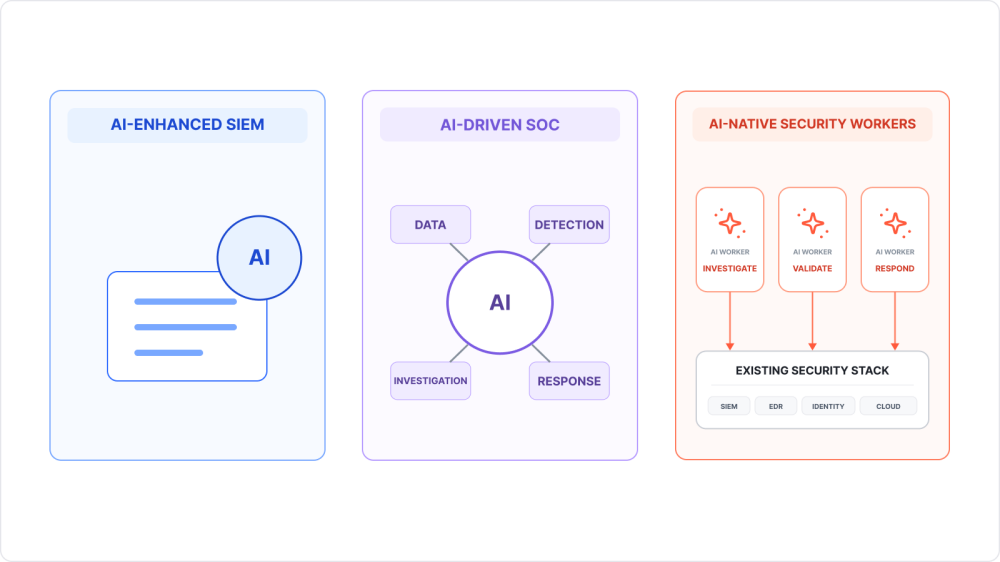
The current market can be understood through three broad architecture patterns. They are not mutually exclusive, and a vendor or enterprise may combine elements of more than one.
AI Enhanced SIEM
An established SIEM adds natural-language search, summarization, copilots, and AI-assisted investigation. This is often the lowest-disruption path for organizations with mature data pipelines, content, workflows, and governance already built around a SIEM.
Unified AI Driven Security Operations Platform
Data, detection, investigation, orchestration, and response operate within a broader platform. Agents can work across the lifecycle because the platform already provides shared context, identity, policy, and telemetry. SIEM remains important, but it functions as one part of a larger operating system for the SOC.
AI Native Security Workers
Agents are designed around tasks and outcomes rather than around a specific security product. They use the organization's existing SIEM, EDR, identity, cloud, and threat intelligence tools to complete investigations or other defined work. This creates an AI execution layer that can span a heterogeneous security stack.
The strategic choice is therefore not simply between legacy SIEM and AI-native SIEM. Organizations must decide where reasoning, context, policy, and execution should live, and how much control they want to retain in each layer.
6. What AI Native Security Requires
A security product does not become AI-native by adding a chat interface or an LLM API. AI-native architecture assigns AI an operational role and provides the controls required for that role to be safe and dependable.
• Context: The system must understand users, assets, identities, applications, telemetry, and historical behavior.
• Reasoning: The agent must build, test, revise, and reject hypotheses as evidence changes.
• Tool access: Agents need controlled access to SIEM, EDR, IAM, cloud, threat intelligence, ticketing, and response systems.
• Evidence: Every conclusion and action should be traceable to the observations and queries that support it.
• Permissions: Policies must define which tools and data an agent may use, which actions require approval, and where autonomy ends.
• Memory: Previous investigations and outcomes should improve continuity without creating uncontrolled or misleading context.
• Governance: Identity, audit records, cost controls, evaluation, rollback, and human intervention must be part of the operating model.
These requirements are architectural, not cosmetic. They determine whether an agent can perform useful work repeatedly while remaining accountable to the organization that deploys it.

7. SecNova AI Perspective
This shift shapes how we design SecNova AI. We start with a practical question: if cybersecurity software were designed in the AI era, which parts of security work should AI perform, and which controls must remain visible to people?
In security operations, that means connecting security data, detection, AI triage, investigation, decision, response, and continuous improvement. The same design principle can extend beyond the SOC to penetration testing and code security, where agents can perform bounded technical work while preserving evidence and approval boundaries.
Our view is that the winning architecture will not be defined by maximum autonomy. It will be defined by trustworthy execution: agents that can use the right context and tools, complete meaningful work, and operate within clear limits for permission, evidence, cost, and accountability.

The Strategic Question
The AI transformation of cybersecurity will unfold through several paths. Existing SIEM platforms will become more intelligent, unified security operations platforms will become more agentic, and AI-native security workers will operate across established tools.
The role assigned to AI is changing. It is moving from helping analysts use security software toward participating directly in security work. The strategic question is how much of that work AI can perform reliably, what evidence it must produce, and how organizations will govern its actions.