
Why security closeout should measure residual access—not closed tickets
The final whistle has blown. Temporary event structures are coming down. Sponsor activations have ended. Project channels are quiet. But inside many organizations, the access created for the World Cup may still be active.
Guest accounts, OAuth grants, API keys, network allowlists, cloud resources, service identities, email forwarding rules, and security exceptions do not disappear when an event ends. They remain until someone finds them, removes them, and proves that the access is gone.
That final verification step matters because attackers are moving faster than ever.
CrowdStrike’s 2026 Global Threat Report puts the average eCrime breakout time at 29 minutes, with the fastest observed breakout taking only 27 seconds. In one intrusion, data exfiltration began within four minutes of initial access.
When adversaries operate in minutes, a monthly access review is too slow to serve as the sole closeout control for a high-risk event.
The Event Ends. The Attack Surface Does Not.
Major events create a predictable burst of temporary trust.
Contractors enter collaboration platforms. Broadcast vendors receive access to streaming systems and object storage. Marketing teams relax email or web controls. Developers create service accounts to meet launch deadlines. Network teams add temporary allowlists. SOC teams suppress noisy detections or add endpoint exclusions to keep production moving.
Most of these decisions are reasonable during the event.
They become dangerous when nobody owns their expiration.
The common response is to disable the user account. That is necessary—but it is not the same as removing every way that identity can continue to act.
Microsoft’s guidance on emergency access revocation makes this limitation clear: an application can issue and control its own session token, and Microsoft Entra ID cannot directly revoke a session created by that application.
Disabling a user can therefore leave other access paths active, including application sessions, delegated OAuth grants, API credentials, forwarding rules, or machine identities created for the same event.
So the first closeout question should not be:
“Did we disable the account?”
It should be:
“What access paths associated with this identity or event can still reach our systems and data?”
Reconcile Four Ledgers—not One Spreadsheet
For this closeout framework, we group temporary trust into four operational ledgers.
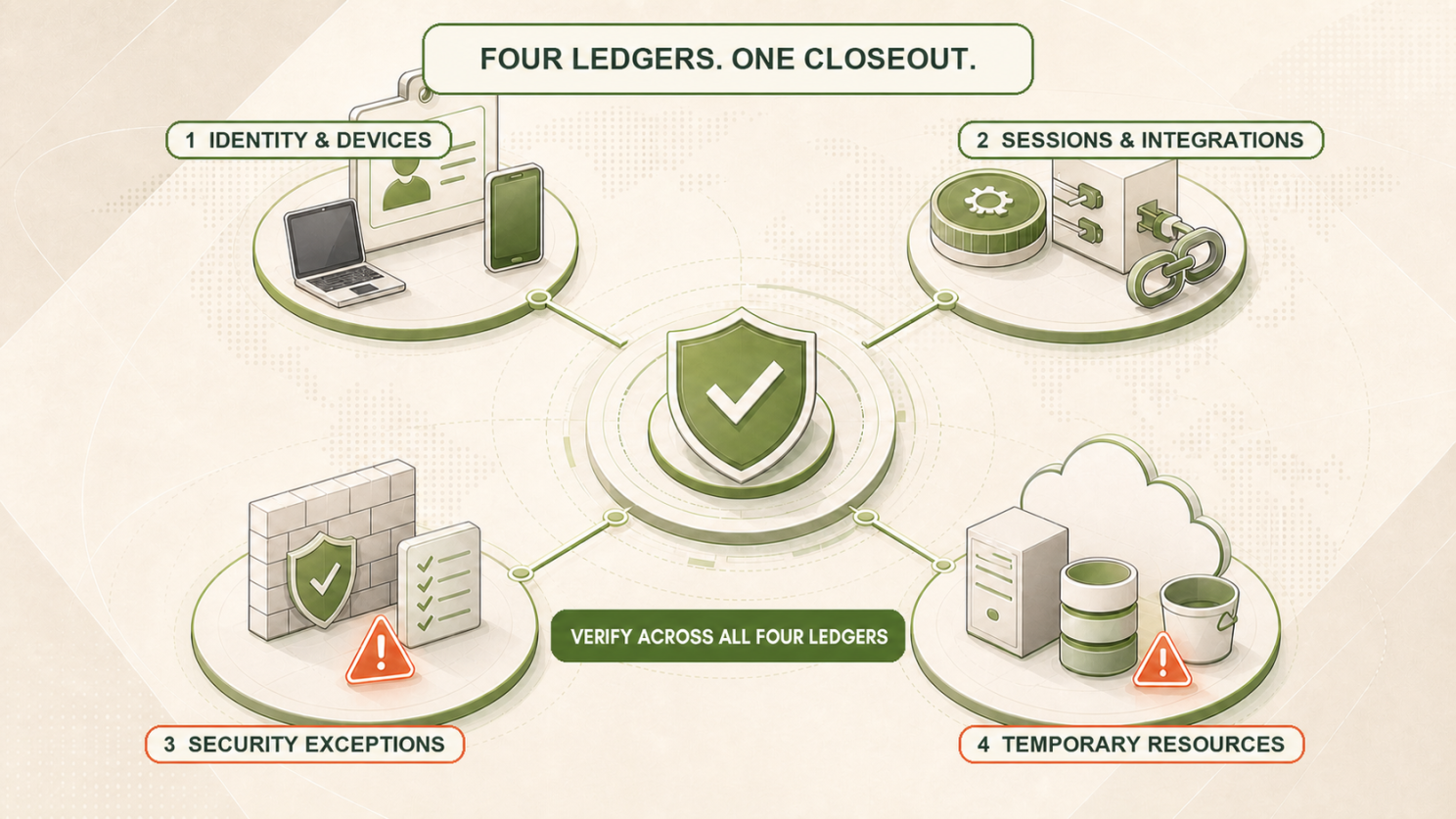
1. Identity and Device Ledger
Include temporary employees, contractors, guest users, vendor identities, emergency administrators, privileged-role eligibility, registered devices, and dormant accounts reactivated for the event.
2. Session and Integration Ledger
Include refresh tokens, application sessions, OAuth consent, service principals, API keys, webhooks, application passwords, automation credentials, and email forwarding rules.
3. Security-Exception Ledger
Include network allowlists, firewall or WAF bypasses, VPN address pools, conditional-access exclusions, detection suppressions, and endpoint-security exclusions.
4. Temporary-Resource Ledger
Include event-specific cloud accounts, storage buckets, CDN configurations, databases, reporting workspaces, log connectors, domains, and SaaS tenants.
These ledgers cannot be built from CMDB data alone. They must be reconciled against identity logs, cloud audit trails, SaaS administration events, network-policy changes, SIEM rule history, and change tickets.
Why?
Because risky patterns often emerge only when individual signals are correlated.
Palo Alto Networks recently illustrated this challenge through a realistic Google Workspace attack chain. OAuth authorization, unusual Drive access, forwarding rules, and security-policy changes can each appear routine when viewed in isolation.
Correlated around the same identity and timeframe, they form a coherent persistence and data-exfiltration path.
Turn Closeout into a SOC Case
Security closeout should have a clock, an owner, supporting evidence, and a clear acceptance condition.

T+0: Freeze and Inventory
Stop the creation of new temporary access.
Export the current identity, application, exception, and resource inventories. Preserve the change records and logs required for verification.
T+24 Hours: Revoke, Rotate, and Restore
Disable temporary identities.
Terminate sessions. Revoke OAuth grants. Rotate temporary or event-specific credentials and keys. Remove forwarding rules. Restore the security baseline.
Event-specific resources should be decommissioned or quarantined once retention requirements have been satisfied.
High-impact actions should follow business approval procedures and include rollback or recovery controls where supported—but they should not wait for the next monthly meeting.
T+7 Days: Verify Again
Run a second zero-state query.
Look for:
- Post-event sign-ins
- Use of old tokens or credentials
- Unexpected external sharing
- Persistent forwarding rules
- Overdue security exceptions
- Dormant-but-enabled identities
- Cloud resources without an accountable owner
The most useful metric is not the number of tickets closed.
For event closeout, we use a metric called:
Time-to-Zero Residual Access
Time-to-Zero Residual Access measures the time between the end of an event and the point at which unauthorized residual access has been eliminated.
Anything that cannot be removed must have four things:
- A named owner
- A documented expiration date
- A compensating control
- Evidence of review
“The business still needs it” is not a closeout state.
Verify the Outcome—not Just the Checklist
Reaching zero residual access requires more than completing a list of cleanup actions. Each action must be followed by evidence that the corresponding access path has actually been closed.
That evidence will come from different systems. Microsoft Sentinel UEBA can help identify unusual post-event activity across users, hosts, IP addresses, and applications. AWS IAM Access Analyzer can surface unused roles, permissions, access keys, and passwords—and, for supported findings, confirm when identified access has been removed after a policy change.
These tools cover only part of this four-part framework. Identity logs, SaaS audit trails, cloud activity, network-policy records, and resource inventories must also be reconciled to verify the full result.
The acceptance standard should remain consistent:
Do not stop at proving that a cleanup action was completed. Prove that the associated access path is no longer usable.
From Closeout Framework to Operational Control

At SecNova AI, we believe security closeout for major events should not be a one-time spreadsheet exercise. It should become a reusable security-operations playbook.
A practical starting point is a direct question:
Which identities, sessions, exceptions, and resources from the World Cup project still lack an owner?
An AI-assisted workflow could help bring together evidence across these areas, support low-risk cleanup, and route higher-impact actions—such as privilege removal, integration shutdown, or resource deletion—through the appropriate approval process.
The resulting SOC report could provide an auditable record of what was removed, how the outcome was verified, and which residual risks were accepted, by whom, and until when.
During a major event, the SOC proves its value by handling the peak.
After the event, it proves its value by removing temporary trust.
The crowd leaving is not the closeout. Closeout means zero unauthorized residual access.
Learn more about SecNova AI-SIEM: www.secnova.ai