SecNova V3.0.3 brings NovaQL to GA, unifying security analytics, detection, visualization, and AI, while introducing a lakehouse architecture, a new AI Agent foundation, and fine-grained log access controls to reduce data costs and strengthen detection and automation.
Key Feature Updates
NovaQL GA
SecNova's self-developed query language for security analytics provides a consistent query capability for analysts, detection rules, visualization dashboards, and AI assistants.
Query Language
- Compatible with commonly used KQL operators, including
where,summarize,extend,project,join,union,distinct,take, andsort. - Supports multi-value expansion and structured data processing, including
mv-expand,mv-apply,arg_max,arg_min,letvariables and subqueries, andmake_seriestime-series queries. - Provides built-in functions for strings, date and time, IP addresses, JSON extraction, aggregation, and more.
- Currently provides approximately 160 analytics operators and functions.
Data Model
Provides a three-layer query view: physical Index + OCSF + data source Dataset.
- Uses OCSF classes as logical data sources, so users do not need to understand the underlying physical indexes, such as
ocsf_events, authentication activity, network activity, or HTTP activity. - Treats entities such as users, endpoints, and devices as first-class citizens.
- Supports querying data through syntax such as
dataset("azure.entra"), without requiring knowledge of the underlying physical storage Index. - Native JSON columns are automatically parsed into structured fields, such as
dst_endpoint.ipandmetadata.product.name, and can be accessed directly through dot-path notation.
Detection Integration
- Detection rules and Context Jobs are both expressed through NovaQL.
- Query results can be written to reference tables or enriched datasets for rule correlation and joins.
AI Capabilities
- Supports generating NovaQL directly from natural language. For example, entering “recent high-risk network events” automatically generates an executable query with a time window and result limit.
- The generation process is aware of user-visible data sources and follows the same permission model.
Security, Multi-Tenancy, and Data Source ACL
- Tenant-level database isolation gives each tenant an independent database boundary.
- User-level data permissions allow Index and data source ACLs to be configured by role, ensuring that users can access only authorized sources.
Editing Experience
- Includes a NovaQL editor with syntax highlighting and catalog and field auto-completion.
- Displays query details with read-only syntax highlighting.

Lakehouse Architecture Upgrade
Significantly reduces data costs and supports long-term compliance storage:
- Hot data storage now uses CK by default. Disk usage is approximately one-third of the previous version.
- Cold data storage uses Iceberg for long-term, low-cost storage in compliance scenarios. Object storage costs are approximately one-tenth of the previous solution.
- All cold data can be queried directly at any time, without importing or loading it.
- NovaQL can query both cold and hot data.
Detection Engine
- Supports NovaQL as the detection syntax.
- The real-time detection engine, currently in Preview, supports defining detection rules with NovaQL over streaming data. A syntax subset is supported; some syntax is available only for Scheduled Queries.
- Adds Context Jobs for scheduled NovaQL tasks. Results can be stored in Reference Tables or physical indexes for rule correlation analysis.

NovaQL-Native Dashboards and Reports
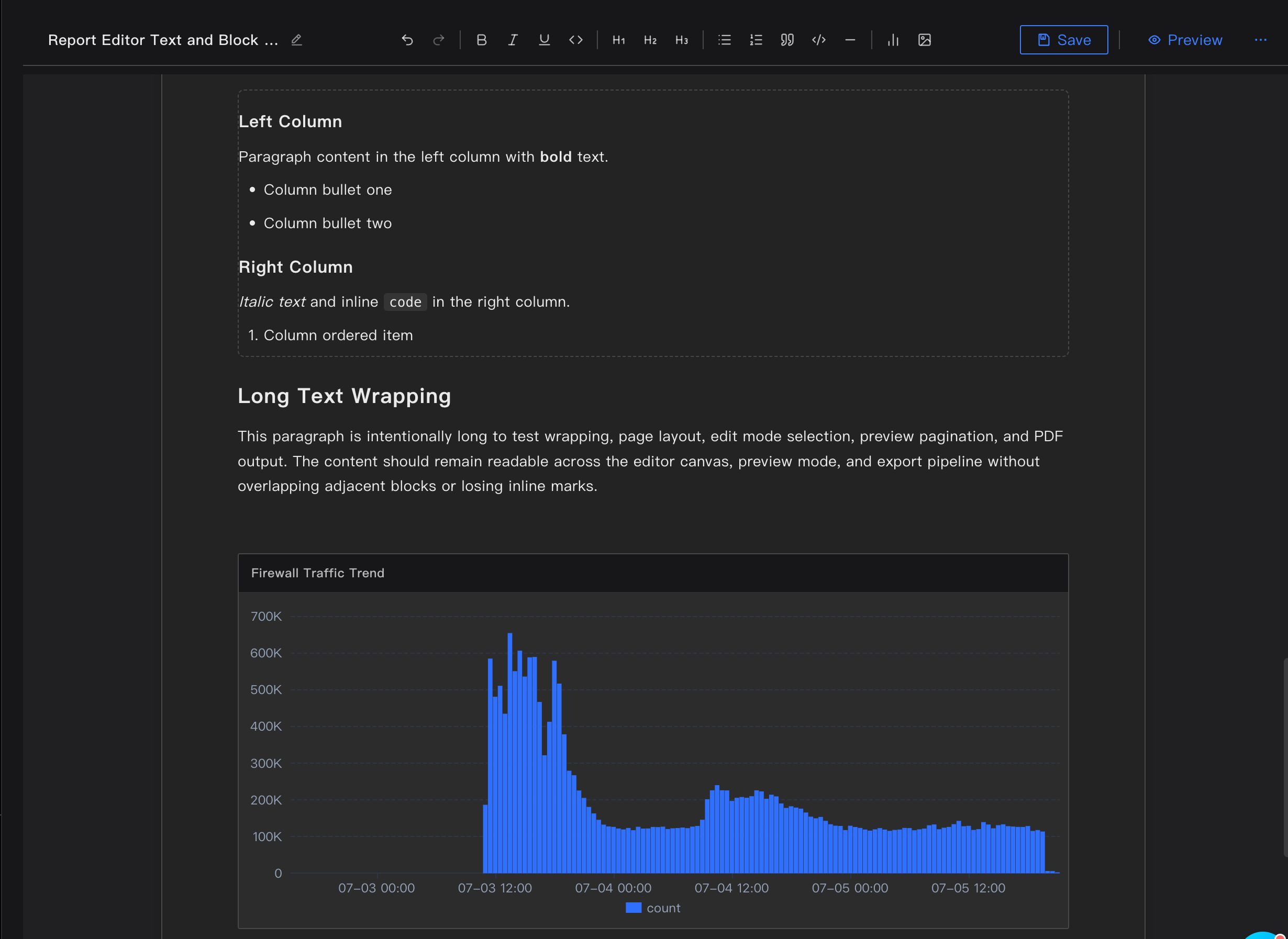
- Supports defining visualization widgets through NovaQL.
- Significantly improves the customization workflow for Reports and Dashboards.

New AI Agent Foundation
- AI Chat first-token latency is significantly reduced, resulting in faster responses.
- The AI tool runtime supports cloud and edge Broker scheduling. AI Agents and automated workflows can interact with customer on-premises environments without requiring VPN tunnels or public network exposure.
- AI tool invocation supports human-in-the-loop approval.
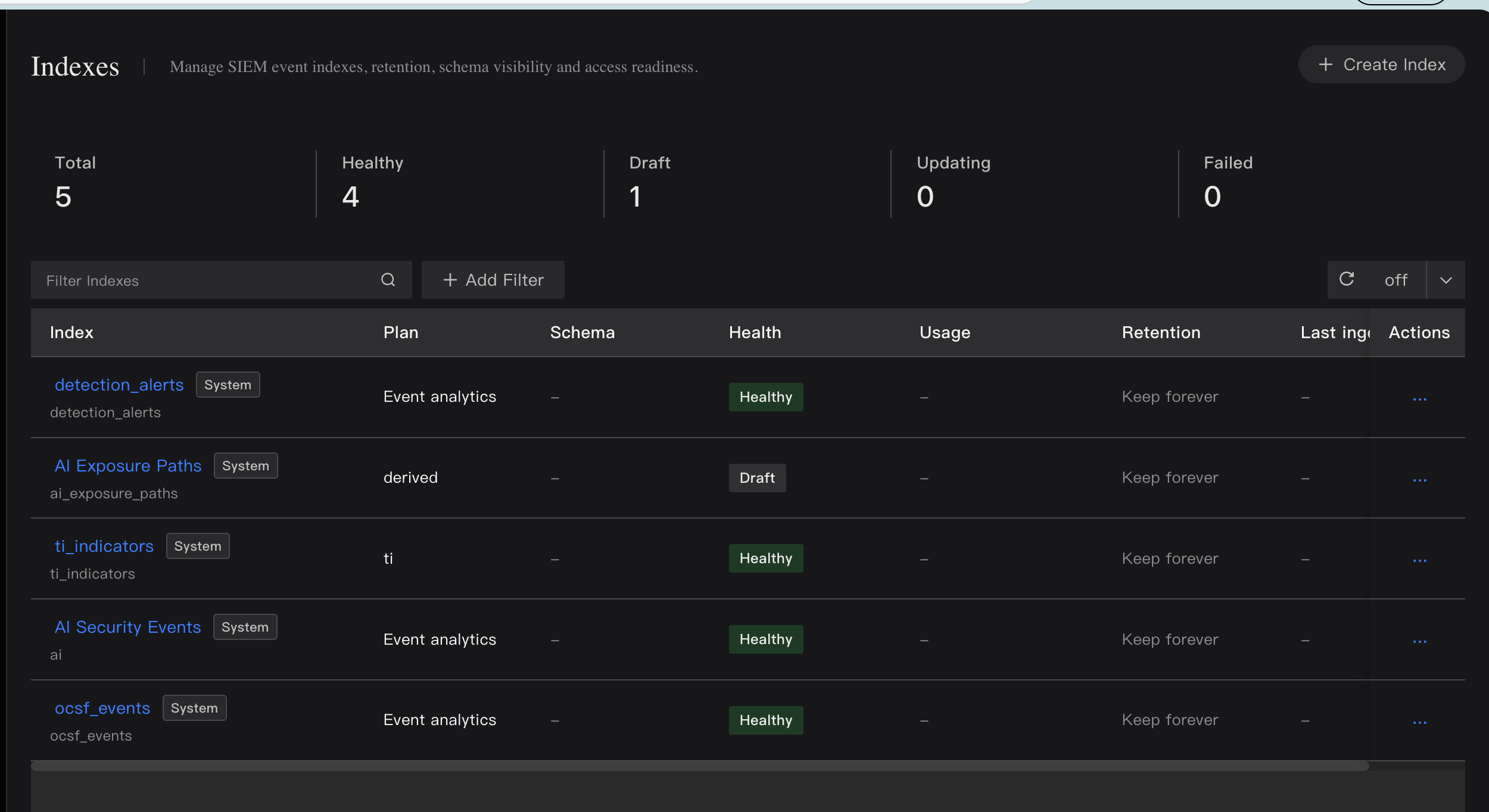
Fine-Grained Log Index Management
- Supports writing different data sources to different physical indexes.
- Physical indexes support independent lifecycle configuration.
- Physical indexes support role-level ACL configuration.